DevWebUI: Local control plane for developer workflows and agent automation
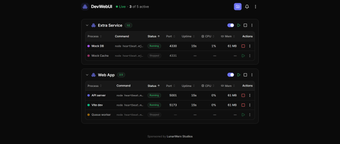
DevWebUI, from LunarWerxs, is a local-first tool for managing multiple development servers and coordinating automation. It provides a centralized interface to control server processes, inspect runtime state, and group services by project. The app's main surface focuses on process lifecycle controls, live observability, and per-project configuration to speed setup. Developers and AI engineers who manage local stacks or experiment with agent-driven workflows gain a single point of control and visibility.
Can AI agents operate the same control surface as a developer?
DevWebUI exposes an integrated Model Context Protocol server that gives programmatic access to the running environment, and the MCP includes 31 tools for agent automation. That arrangement lets automation agents perform the same actions the human-facing dashboard does, including interacting with process state and reading error output; the design creates a single, shared state that both manual users and agents act upon.
How useful are the observability and log outputs for debugging?
The app provides live visibility into CPU use, memory consumption, and process logs, and it applies de-duplicated error logging to reduce repeated noise when problems recur. Automatic port-conflict detection flags collisions before a process starts, and combined metrics plus pruned logs make it easier to identify the root cause of a failing dev server without chasing redundant messages.
What does project setup and integration require?
Project configuration relies on a small .devwebui file placed in a repository root; that file lists a project's servers, groups processes under a header, and enables auto-reload on launch. The tool integrates with common local servers such as Vite and Bun by controlling their processes, and it runs locally while providing a browser-accessible control plane for development machines.
How does it fit into local workflows and community practice?
DevWebUI is open-source and designed for local development-first use, and it is recognized among AI developers for linking local processes with automation tools. Compared with traditional process managers it emphasizes a shared human-and-automation interface, making it relevant to teams that experiment with agent-driven development rather than only hands-on process supervision.
Best suited to developers who prioritise local control and automation experiments
LunarWerxs's focus on open-source, local-first tooling positions this app as a practical option for engineers who want a single control plane on their machine while exploring agent workflows. Expect tangible gains in coordination and observability when coordinating multiple local servers, and plan governance for automated agent access to keep development systems predictable and secure.